Bakery Window Coloring Scene (Kindergarten)
A detailed Bakery Window scene to color, describe, and turn into a writing prompt.
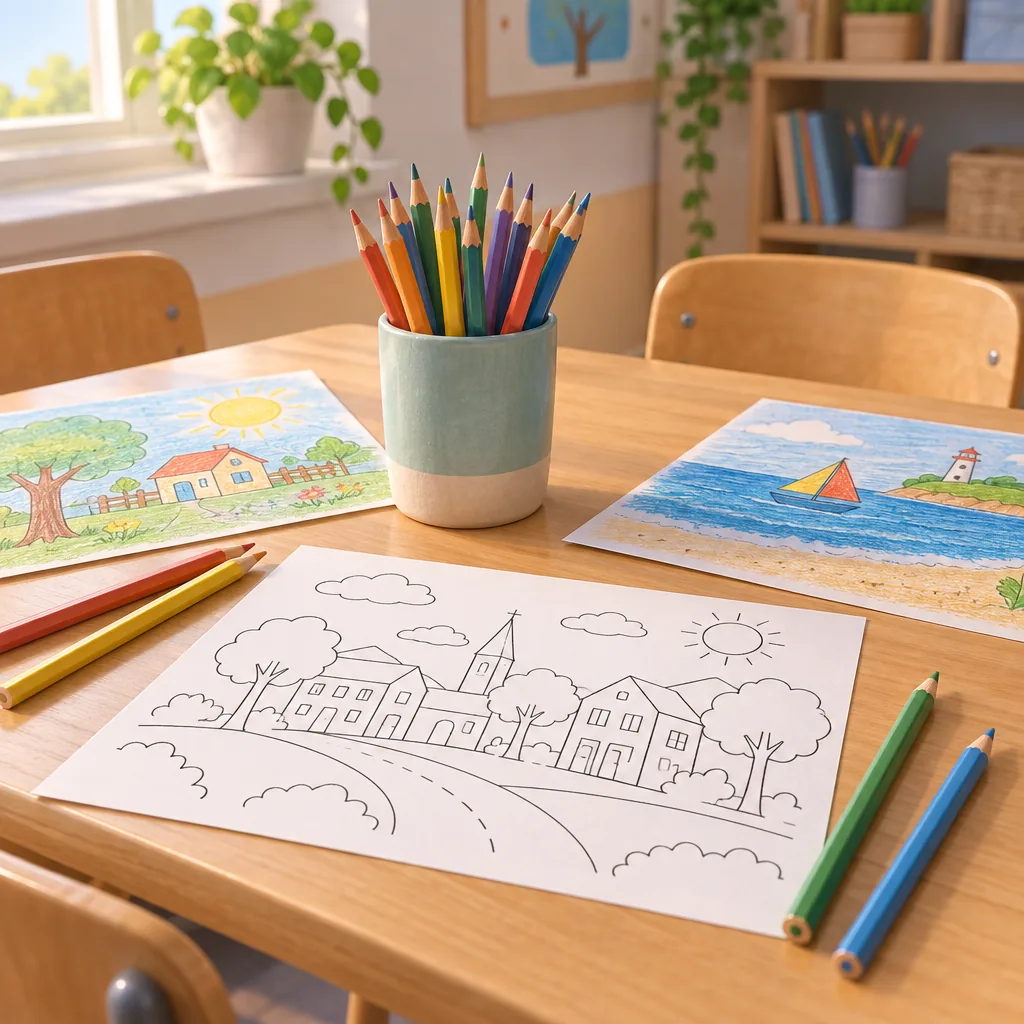
This printable is a more detailed bakery window coloring scene aimed at Kindergarten learners. The page has multiple small spaces to color, small story details to discover, and a writing prompt at the bottom that turns the activity into a complete language lesson.
What's on this printable
A full Bakery Window scene that fills the page, with several distinct elements to color and a one-sentence writing prompt at the bottom. The internal spaces are smaller than a preschool page but still large enough for a five-year-old to color comfortably. The page is designed to print cleanly on a single sheet of standard letter or A4 paper, with clear margins for binding or hole-punching, and uses thick black outlines that hold up well even on draft-quality classroom printers.
Skill focus and developmental fit
Kindergarten coloring works three skills at once: visual-motor control (smaller spaces, more accuracy), sustained attention (more details to finish), and oral or written language (the scene invites narration). It is one of the most efficient activities you can put in front of a five-year-old. This printable is best suited for ages 3 to 8 — old enough to engage independently with the task, young enough that the skill being practiced is still actively developing. If a child finishes this page in under three minutes with no errors, it is likely time to move up to a more challenging variation; if they cannot complete it without help, drop down to a simpler page in the same category and try again in a week.
How to use this page at home or in the classroom
Color the page first, then ask the child to tell you what is happening. For older Kindergartners, have them write a sentence on the bottom prompt line. Display finished pages on a 'Story Wall' to celebrate the writing. Keep the session short — five to ten minutes of focused practice at this age beats a long, distracted session every time. Print one page per child, gather the supplies before you start (pencils, crayons, scissors, glue if needed), and clear the table of distractions.
Pairing ideas and extension activities
Use the scene as the launch for a longer story — the child draws what happens next on a blank piece of paper. Pair with a related read-aloud or a quick research question. Save the finished page in a take-home folder so families can see the week's work, and rotate the same skill into a different format the following week to reinforce learning without boring the child. Display a few finished pages on a bulletin board or fridge to give the child the visible signal that this work matters.
Why this matters in early childhood
Activities like this one look simple from the outside, but they are doing real cognitive and motor work under the hood. Small, focused practice tasks — done daily, in short bursts, with a friendly adult nearby — are the single most effective way to build the foundational skills that early elementary success rests on. Use this printable as one small piece of that bigger picture, not as the whole picture, and pair it with conversation, read-alouds, and play whenever possible.
How to use this worksheet
- Color first, talk second.
- Use the bottom prompt line for an early writing attempt.
- Display the finished work to celebrate the writing.
- Pair with a related book for a richer activity.
Skills practiced
- Detailed coloring
- Oral storytelling
- Early writing
- Visual-motor control
Tips for parents and teachers
If the child resists the writing prompt, scribe the sentence for them and have them copy it. The 'I wrote a story today' moment matters more than the independent letter formation at this stage.