Letter H Tracing — Uppercase and Lowercase
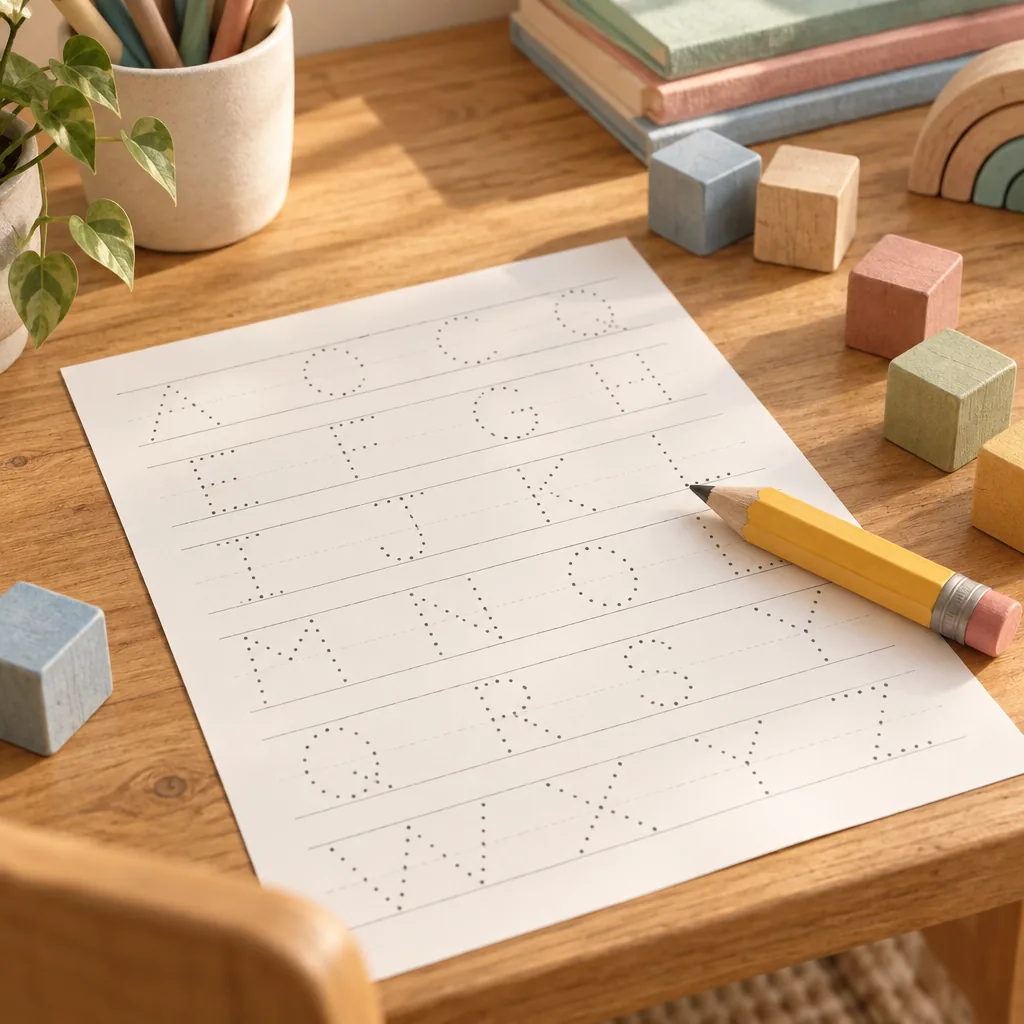
A guided tracing page for the letter H — uppercase and lowercase, with arrows, dotted guide lines, and a finishing row of independent practice.
This printable focuses on the letter H. The page opens with a large model of the uppercase H and the lowercase h, each with a starting dot and directional arrows that show the correct stroke order. Below the model, two rows of dotted-guide tracing give the child the chance to repeat the formation several times before attempting the letter independently on the final blank row.
What's on this printable
Top of the page: an oversized H with stroke arrows. Middle: four lines of dotted-guide tracing, alternating uppercase and lowercase. Bottom: a blank handwriting row with a sky/grass/dirt three-line baseline so the child can attempt the letter without dotted guides. There is also a small picture clue — an everyday object that begins with H — to anchor the letter to a familiar word. The page is designed to print cleanly on a single sheet of standard letter or A4 paper, with clear margins for binding or hole-punching, and uses thick black outlines that hold up well even on draft-quality classroom printers.
Skill focus and developmental fit
Letter formation in early childhood is a fine-motor task first and a language task second. The child has to plan the stroke, control the pencil, stop at the right spot, and start the next stroke in the right place. By breaking the task into a model, guided practice, and independent practice, this page scaffolds the formation in the same sequence that occupational therapists recommend. This printable is best suited for ages 3 to 8 — old enough to engage independently with the task, young enough that the skill being practiced is still actively developing. If a child finishes this page in under three minutes with no errors, it is likely time to move up to a more challenging variation; if they cannot complete it without help, drop down to a simpler page in the same category and try again in a week.
How to use this page at home or in the classroom
Print one page per child. Have the learner trace each letter slowly, naming the strokes out loud ("down, down, across" for the uppercase H). Ask the child to circle their best try at the end of the row. For an extra sensory layer, finger-trace the large model letter at the top three times before picking up the pencil. Keep the session short — five to ten minutes of focused practice at this age beats a long, distracted session every time. Print one page per child, gather the supplies before you start (pencils, crayons, scissors, glue if needed), and clear the table of distractions.
Pairing ideas and extension activities
Pair this page with a play-dough H, a sand-tray H, or a magnetic H on a cookie sheet. Read a picture book whose title or main character starts with H, and ask the child to point out the letter every time they see it on the cover. Keep all of a child's tracing pages in a binder so they can flip back through their own progress. Save the finished page in a take-home folder so families can see the week's work, and rotate the same skill into a different format the following week to reinforce learning without boring the child. Display a few finished pages on a bulletin board or fridge to give the child the visible signal that this work matters.
Why this matters in early childhood
Activities like this one look simple from the outside, but they are doing real cognitive and motor work under the hood. Small, focused practice tasks — done daily, in short bursts, with a friendly adult nearby — are the single most effective way to build the foundational skills that early elementary success rests on. Use this printable as one small piece of that bigger picture, not as the whole picture, and pair it with conversation, read-alouds, and play whenever possible.
How to use this worksheet
- Start with finger-tracing the large model letter three times before picking up a pencil.
- Encourage the child to say each stroke out loud as they trace.
- Have them circle the best-formed letter at the end of each row.
- Stop after one page — short, focused practice beats long sessions at this age.
Skills practiced
- Letter formation and stroke sequence
- Pencil grip and control
- Letter-sound association
- Visual-motor integration
Tips for parents and teachers
Watch the pencil grip more than the finished letter. A relaxed tripod grip with the paper tilted slightly toward the writing hand makes everything easier — wobbly letters at this age usually mean a tense grip, not a learning problem.